For all international sourcing professionals, the Canton Fair is an unmissable event. Twice a year in Guangzhou, thousands of buyers and manufacturers gather to identify new products, meet suppliers and keep up with market trends.
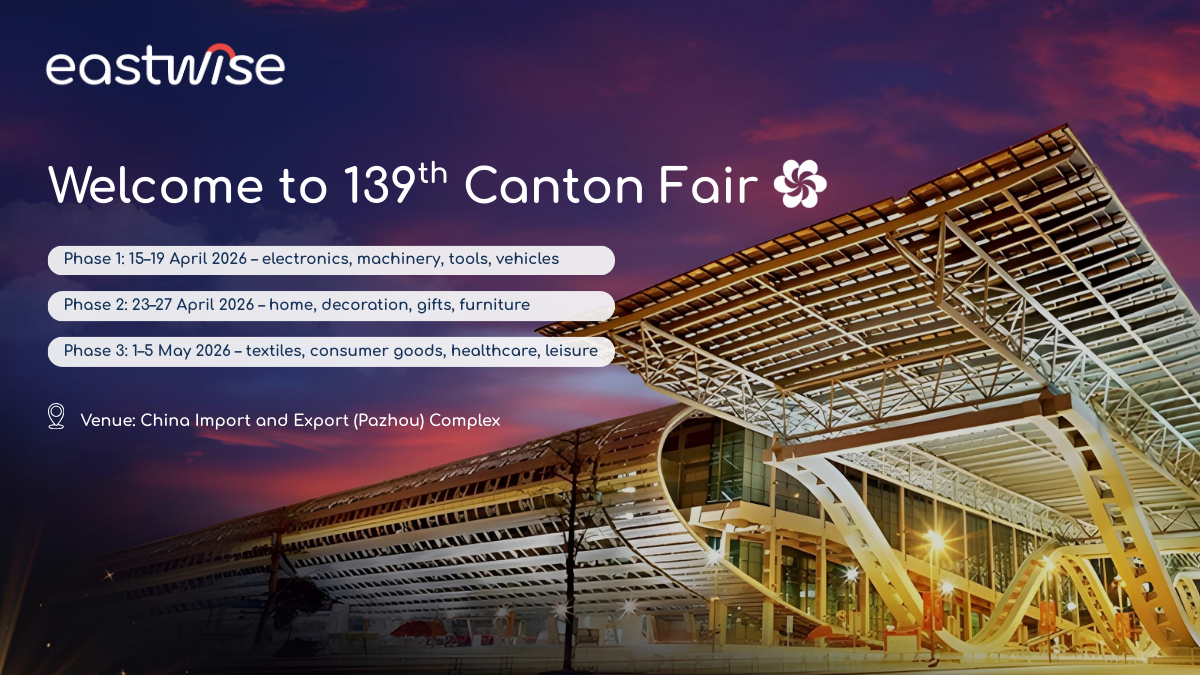
The Spring 2026 (Q2) edition will take place on the following dates:
- Phase 1: 15–19 April 2026 – electronics, machinery, tools, vehicles
- Phase 2: 23–27 April 2026 – home, decoration, gifts, furniture
- Phase 3: 1–5 May 2026 – textiles, consumer goods, healthcare, leisure
But for companies sourcing from Asia, one reality quickly becomes apparent:
👉 The Canton Fair accounts for just 30% of the work.
The remaining 70% hinges on preparation, follow-up and execution.
Here’s how to structure your approach effectively before, during and after the Canton Fair.
Before the Canton Fair: clarify your sourcing strategy
Such a vast trade fair can be extremely productive … or completely ineffective if you haven’t prepared properly beforehand.
Set clear objectives
Before you set off, it is essential to know exactly what you are looking for.
This could include, for example:
- sourcing new product categories
- identifying new suppliers
- finding alternatives to existing suppliers
- conducting market and product innovation research
- carrying out a price/quality benchmark
It is also useful to define:
- your target volumes
- acceptable MOQs
- target markets (Europe, US, etc.)
These elements enable you to have concrete and effective discussions with manufacturers.
Pre-select the suppliers you wish to meet
With several thousand exhibitors, it is difficult to improvise on the spot.
Best practice is to identify suppliers in advance, via:
- the Canton Fair catalogue
- professional recommendations
- LinkedIn or your network
It is also useful to prioritise stands by hall, according to the product categories you are looking for.
Prepare your buyer’s tools
To compare suppliers effectively, it is recommended that you arrive with structured tools:
- product sheets or technical briefs
- quality specifications and required standards (CE, LFGB, REACH, etc.)
- comparison grids: price, MOQ, lead time, packaging, certifications
- target cost / price objectives
These documents enable you to obtain precise answers right from the initial discussions.
Scheduling meetings
It is often useful to contact certain suppliers before the fair to arrange meetings.
This allows you to:
- secure important meetings
- prepare for technical discussions
- set aside time to explore new stands
During the Canton Fair: gathering the right information
Once there, the aim is simple: to gather as much useful information as possible for sourcing.
Some best practices:
- collect business cards or WeChat QR codes
- photograph products and stands (with permission)
- systematically ask suppliers the same questions
For example: MOQ, price, lead time, factory capacity, packaging, certifications, and availability of samples
A simple but often overlooked rule:
👉 Take notes immediately after each discussion.
It is also good practice to sort through suppliers each evening and jot down your impressions whilst the information is still fresh.
After the Canton Fair: the real work begins
This is often the most underestimated stage… yet it is the most strategic.
Organise and refine the information
After the fair, it is essential to centralise:
- contacts
- photos
- notes
- brochures
Then quickly eliminate irrelevant suppliers.
Issuing RFQs
The next step is to send RFQs (Requests for Quotation) to the shortlisted suppliers.
An effective RFQ should include:
- technical specifications
- target volumes
- Incoterms
- quality requirements
- packaging
- project timeline
Comparing suppliers
Responses can then be analysed using a structured comparison table, including:
- price
- MOQ
- lead time
- flexibility
- perceived quality
It is also at this stage that potential risks are identified: quality, production capacity or communication.
Samples and testing
Before any supplier approval, it is recommended to:
- order targeted samples
- carry out a third-party inspection if necessary
- initiate quality and compliance testing
Final approval can be carried out via:
- a supplier visit
- receipt of samples in Europe
- or remote approval.
Negotiation and listing
Once suppliers have been approved:
- final negotiation (price, MOQ, packaging, etc.)
- supplier approval (audit if necessary)
- product listing
- placement of the first orders
Turning the Canton Fair into a tangible opportunity
Taking part in the Canton Fair can be extremely powerful… provided the sourcing process is well structured.
👉 The Canton Fair accounts for only 30% of the work.
The rest depends on preparation, analysis and follow-up.
How EASTWISE can support you
At EASTWISE, we support our clients at every stage of sourcing in Asia:
- pre-trade fair strategic planning
- on-site support
- supplier qualification
- quality inspections
- production management
- supply chain security
Our local teams can assist:
- throughout the entire sourcing process
- or via bespoke services, depending on your needs.
 Discover our solutions:
Eastwise Purchasing Solutions
Eastwise Services
 Contact us to discuss.