For decades, China has established itself as a key manufacturing base for global sourcing. Its industrial ecosystem, infrastructure, extensive supplier network, and production capabilities continue to make it a highly efficient market for a wide range of product categories.
However, in an environment shaped by changing tariffs, geopolitical tensions, and supply chain disruptions, relying on a single geography can increase exposure to risk.
This is where China+1 and dual-sourcing strategies come into play.
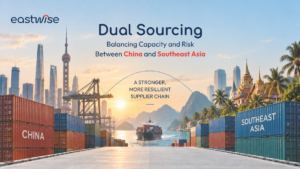
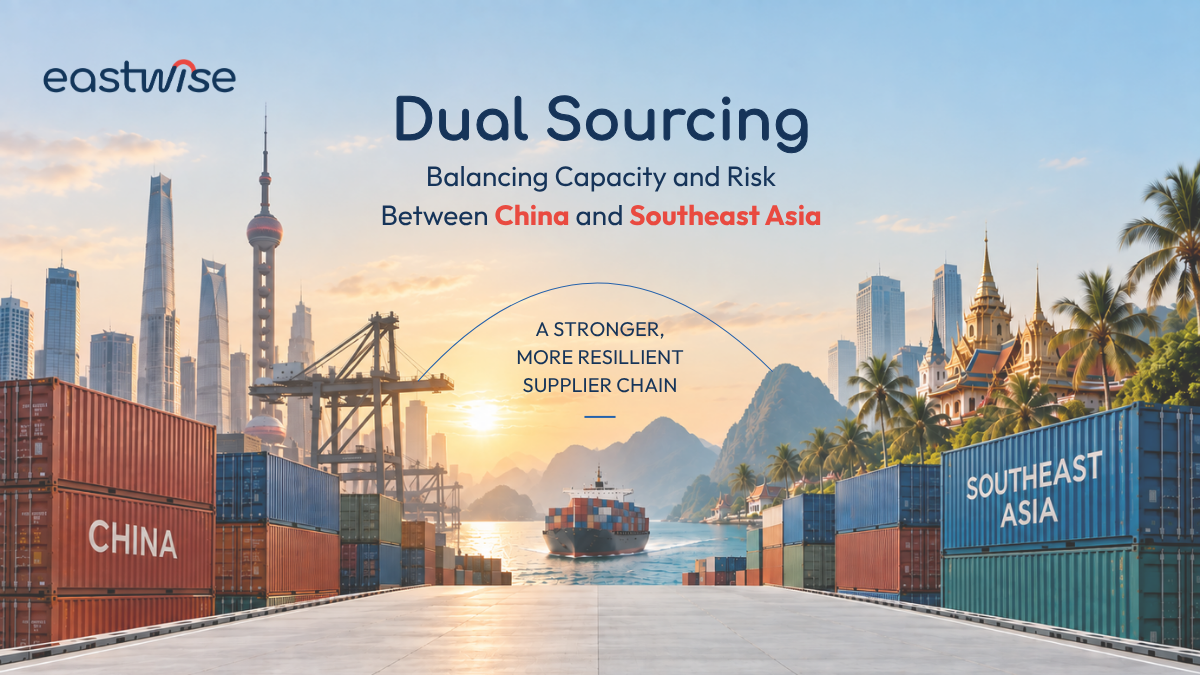
The objective is not to replace China but to complement an existing sourcing base with alternative capacity in Southeast Asia, creating the right balance between performance, capacity, and resilience.
Why Implement a Dual-Sourcing Strategy?
China remains one of the world’s most developed manufacturing bases, with significant advantages in terms of capacity, expertise, infrastructure, and supplier ecosystems.
A diversification strategy does not, therefore, necessarily mean moving away from China.
The China+1 approach is about maintaining a presence in China while developing one or more alternatives in other Asian markets. This is a trend we have been following for several years at EASTWISE. To explore the topic further, read our article on China Plus One strategy and supplier diversification in Asia.
Southeast Asia can provide a relevant complementary sourcing base for certain product categories, depending on available manufacturing capabilities, costs, infrastructure, quality requirements, and destination markets.
Dual sourcing is not about choosing between efficiency and resilience: it is about finding the right balance between the two.
What Does a Balanced China–Southeast Asia Model Look Like?
In a dual-sourcing model, the two sources do not necessarily play the same role.
China may, for example, remain the primary source for strategic or high-volume production, while a supplier in Southeast Asia acts as an active secondary source, providing additional capacity and progressively taking on more volume when required.
Allocations such as 80/20 or 70/30 can be used as reference points, but there is no universal model.
The right balance depends on factors including:
- the product and its complexity;
- the volumes involved;
- the capacity available from each supplier;
- costs and lead times;
- logistical and regulatory constraints;
- the level of risk the company is seeking to reduce.
One point, however, is essential: a secondary source is only truly useful if it remains active. The volume allocated to it should be sufficient to keep processes, expertise, and the supplier relationship operational while enabling the supplier to scale up quickly when required.
How to Build a Dual-Sourcing Strategy
Diversifying your supply chain is not simply a matter of identifying a new supplier in another country.
The transition should be gradual, structured, and validated at every stage.
1 — Assess
The first step is to map the current situation.
How much of your sourcing currently depends on China? Which suppliers, components or product categories represent the highest concentrations of risk?
The next step is to identify the products for which diversification is both relevant and realistic.
2 — Select
Not every product is necessarily suitable for partial relocation to Southeast Asia.
Different markets and suppliers should be assessed against several criteria: manufacturing capability, costs, quality, available capacity, infrastructure, lead times, and the logistics environment.
The objective is not simply to identify the lowest-cost country but to find the one offering the best overall combination for the product concerned and the company’s objectives.
3 — Qualify
Once potential suppliers have been identified, their actual capabilities need to be verified.
This phase includes assessing production capabilities, quality systems, and technical and regulatory requirements, as well as the availability of raw materials and components.
Qualification begins with the very first discussions with a supplier. Production capacity, certifications, subcontracting, quality control… these are all areas that should be checked before moving forward. You can also read our 10 questions to ask a new supplier in Asia to help structure this initial assessment.
Changing the location of final assembly does not automatically mean diversifying the entire supply chain.
4 — Pilot
Before transferring significant volumes, it is advisable to begin with a pilot production run.
This stage provides an opportunity to assess:
quality • costs • lead times • capacity • operational performance
The results should be measured against the objectives defined at the outset before increasing the allocation.
The principle is simple: validate before scaling.
5 — Scale
Once the new source has demonstrated its ability to meet expectations, volumes can be increased progressively.
The allocation can evolve in stages according to observed performance, available capacity, and diversification objectives.
The key is to keep the secondary source sufficiently active so that it remains qualified, operational, and ready to scale when required.
What Can Undermine the Strategy?
A China–Southeast Asia strategy may appear diversified on paper without being genuinely diversified in practice.
Several factors can undermine the model.
Indirect dependency on China
A Southeast Asian supplier may itself depend heavily on Chinese raw materials or components. It is therefore important to look beyond the Tier 1 supplier and understand the origin of key inputs.
An attractive factory price but a higher total cost
Comparing unit prices alone can be misleading. Freight, duties, tooling, inventory, lead times and quality-related costs should all be considered as part of the total landed cost.
A qualified but inactive secondary source
A supplier that has been tested once and then left without production for an extended period may not provide immediately available backup capacity.
Capacity that cannot be scaled quickly
It is also essential to verify that the secondary supplier has the equipment, resources, materials and organization required to absorb additional volumes at short notice.
Country-of-origin or tariff requirements that have not been properly assessed
Moving final assembly does not always change the customs origin of a product. Applicable rules must be assessed according to the product and its destination market.
 REAL-WORLD EXAMPLE — CERAMICS:
 The ceramics sector provides a good example of the value of a China+1 strategy. As tariffs and import conditions evolve, some companies may benefit from reassessing their dependency on a single production geography and exploring alternatives in Southeast Asia.
But diversification is not simply about moving production: manufacturing capabilities, raw materials, quality, costs, rules of origin, and logistics all need to be considered as part of the wider picture.
To explore this example further, read our analysis: “Ceramic Sourcing After April 2026: Is It Time to Strengthen Your China+1 Strategy?”
Finding the Right Balance Rather Than Choosing a Country
A successful dual-sourcing strategy is not about choosing between China and Southeast Asia but about using the strengths of each market to build a more balanced supply chain.
The right model depends on the company’s products, supplier network, volumes, destination markets, and risk exposure.
At EASTWISE, we support companies throughout this process, from analyzing their existing sourcing base and identifying and qualifying new sources to managing initial production runs and supporting the scale-up process.
Ready to Take the Next Step?
To help you move from strategy to action, we have prepared two practical resources to download:
A selection of key trade fairs in China and Southeast Asia, with the dates to add to your calendar to identify new opportunities, meet suppliers, and explore new markets.
A practical five-step framework to structure your approach: Assess • Select • Qualify • Pilot • Scale.
Build a supply chain that does not rely on a single option, but on a carefully managed balance between capacity, cost and risk.